
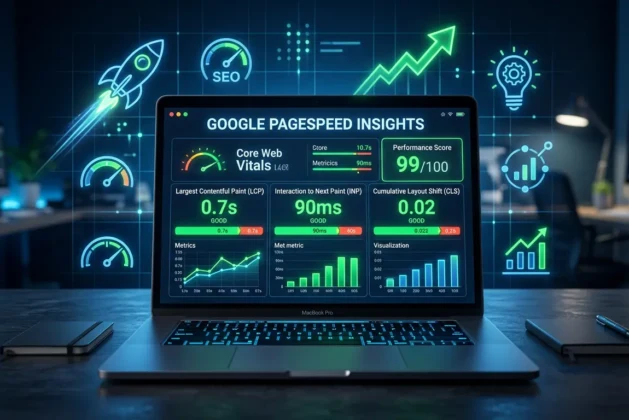
The most important to Technical SEO Experts in 2026 are likely Core Web Vitals as Google continues its transition to a user-experience-centric platform. Use this guide as a compass to direct you towards actionable steps, tips beyond what we can find on official go-to docs and references and set with your optimization strategy.
What are Core Web Vitals?
Core Web Vitals is a three-metric playbook that can, together, offer insights into the real-world experience of your users: Largest Contentful Paint (LCP), Interaction to Next paint (INP) and Cumulative Layout Shift (CLS). They first debuted together with the Google CWV updates on ranking signals from July 2021 through September 2026, which collected CrUX field data.
These metrics measure loading speed, interactivity and visual stability — three vital factors for retaining visitors on your page longer and increasing rankings.
Understanding Largest Contentful Paint (LCP)
LCP records when the largest element on your page loads, usually your main hero image or text block. That can see a dramatic change in perceived page speed, with 75% of users expecting loading time to be lower than 2 seconds.
LCP Thresholds and Impact
- Good: ≤2.5s
- Needs Improvement: 2.5-4s
- Poor: >4s
LCP is poor leads to 32% higher bounce rates. For every additional second of delay, e-commerce sites lose 7% as conversions.
Diagnosing LCP Issues
There are many tools available for you to do this yourself—start with Google PageSpeed Insights or Lighthouse audits Some of the more common offenders include:
- Server response time (time to first byte >600ms)
- Render-blocking JavaScript/CSS
- It is a single page app, so there is client-side rendering.
User LCP in Search Console’s field data, lab data only business health checks Pro Tip
Optimizing LCP: Actionable Steps
1. Improve Server Response Time
TTFB reduction by edge compute (Cloudflare Workers / Vercel Edge Functions) Aim for :
`2. Preload Critical Resources
Add `<link rel=”preload”>` for hero images and fonts:
<link rel="preload" href="/hero.jpg" as="image">

<link rel="preload" href="/font.woff2" as="font" type="font/woff2" crossorigin>
3.Optimize Images
That’s sb. For see or servedef solutions like webp, avif with answer sizes Use `<picture>` elements:
<picture>

  <source srcset="hero.avif" type="image/avif">

  <img src="hero.webp" loading="eager" alt="Main Hero">

</picture>
4. Eliminate Render-Blocking Resources
Defer non-critical JS: `<script defer src=”script.js”>`. Minify CSS and inline critical styles using tools like Critical CSS Generator.
Lazy-load offscreen images with loading=”lazy”. Minimize to Services such as Critical CSS Generator can minify your CSS and offer you with the context of what must be inlined as important styles.
Common Issues: Why Image Optimization Matters
Case Study: Etsy reduced LCP by 50% via image optimization, increasing organic traffic 15%
The Launch of Interaction to Next Paint(INP)
INP, which took responsiveness from click to paint into account, suppressed FID in March 2024. It records mouse clicks, taps and keystrokes throughout the viewport.
INP Thresholds
- Good: ≤200ms
- Needs Improvement: 200-500ms
- Poor: >500ms
Slow INP is caused by lengthy main-thread tasks (>50ms) and those are typical on heavy JS sites.
Diagnosing INP Bottlenecks
Long Tasks in Chrome DevTools Performance panel Third party script queueing introduces latency and inefficiencies.
Optimizing INP: Technical Strategies
1.Break Up Long Tasks
Use requestIdleCallback for non-urgent work:
`javascript

requestIdleCallback(() => {

// Analytics or non-critical code

});

Web Workers offload computations:
`javascript
const worker = new Worker(‘heavy-task. js’);
2.Optimize Third-Party Scripts
Lazy-load analytics:
“`html
<script defer src="gtag.js"></script>Use `rel=”preconnect”` for CDNs.
3.Reduce Input Delays
Prioritize input handlers. Serve Google Fonts Locally There is two reason why we need to serve the requested from directly served from a server instance not third party request.
For example, the Washington Post Case Study: They used INPfrom 40%block to front page with minor javascript optimizations that increased engagement up to 12%.
4.JavaScript Execution Optimization
You also have dynamic imports ( import(/* webpackChunkName: “lazy” */ ‘ /lazy )) for bundle splitting. js’). Tree-shaking removes dead code.
Best Ways To Fix Conditional Layout Shift (CLS)
The new, less informative metric is called CLS — for “cumulative layout shift. Score = impact fraction * distance fraction.
CLS Thresholds
- Good: ≤0.1
- Needs Improvement: 0.1-0.25
- Poor: >0.25
70% of the shifts are caused by images late-load, ads, and dynamic content.
Identifying CLS Culprits
The Search Console will also similar column page issues under “Core Web Vitals report”DevTools highlights shifting elements.
CLS Optimization Techniques
1.Reserve Space for Images/Ads
Set explicit dimensions:
`Html
<img src="ad.jpg" width="300" height="250" style="width:300px;height:250px;">2.Prevent Font Shift (FOIT/FOUT)
Use font-display: swap:
@font-face {

font-family: 'Custom';

src: url('font.woff2');

font-display: swap;

}
Use the same technique mentioned earlier to preload the web font
3.Stabilize Dynamic Content
For embeds:
`html
<div style="height:200px;">
<iframe src="youtube.com/embed/..." style="width:100%;height:100%;"></iframe>
</div>
Do not insert a DOM over viewport without reserved space
For example, after optimizing its fonts around 90% BBC News time-on-page have increased and CLS decreased.
Core Web Vitals Audit Checklist
| Metric | Optimization Steps | Tools |
|---|---|---|
| LCP | Server TTFB, preload, images | PageSpeed Insights, GTmetrix |
| INP | Long tasks, JS bundles, workers | Chrome DevTools, Web Vitals Extension |
| CLS | Dimensions, fonts, embeds | Search Console, Lighthouse |
Run weekly audits. Monitor via Search Console for field data.
The Definitive 2026 Technical SEO Guide
Schema and Structured Data
Enable rich results with Organization and Breadcrumb List schema You can refer Google’s Structured Data Testing Tool.
`json
{

"@context": "https://schema.org",

"@type": "Article",

“headline”: “Passion for technical SEO is all you need Passion for technical SEO is all you need
}
Mobile Optimization
Check viewport meta: “ Test using Mobile-Friendly test.
JavaScript SEO
Server-side rendering (SSR) with Next. js or Nuxt. js for crawlers. Prerender critical paths.
Measuring Success and Monitoring
Real time Vitals + Google Analytics 4 integration Alerting >10% regress
Tools Comparison:
- PageSpeed Insights: Data from Google’s testing lab.
- WebPageTest: Detailed waterfalls.
- CrUX Dashboard Latest data till October 2023
- Search Console: Aim for green (90th Percentile) or better
Common Pitfalls and Fixes
- Pitfall Disregarding mobile vitals when you have 40% traffic mobile.
- Solution: Responsive + AMP (if any) Pitfall:
- Over-optimizing leads to poor experience.
- Corrected: A/B testing with Optimizely.
Dope Work From Industry Professionals
- Shopify: LCP 50% reduced using CDN, +9% revenue increase
- Pinterest: INP KPI drove +12% traffic growth
- New York Times CLS packs fixes dwelling time improved 24%
- These convert into ROI: sites who pass vitals have 24% lower bounce rates.
Future-Proofing for 2026 Algorithms
Gemini 2.0 search and vitals weighed even more Integrated passkeys, privacy signals March 2026 core update for Google (Search Console)
Ongoing experiments auditing, related to E-E-A-T | Technical SEO Expert Google Analytics and Search Console certifications
You have any question of this topic, pleasr Ask A Question

Leave a comment